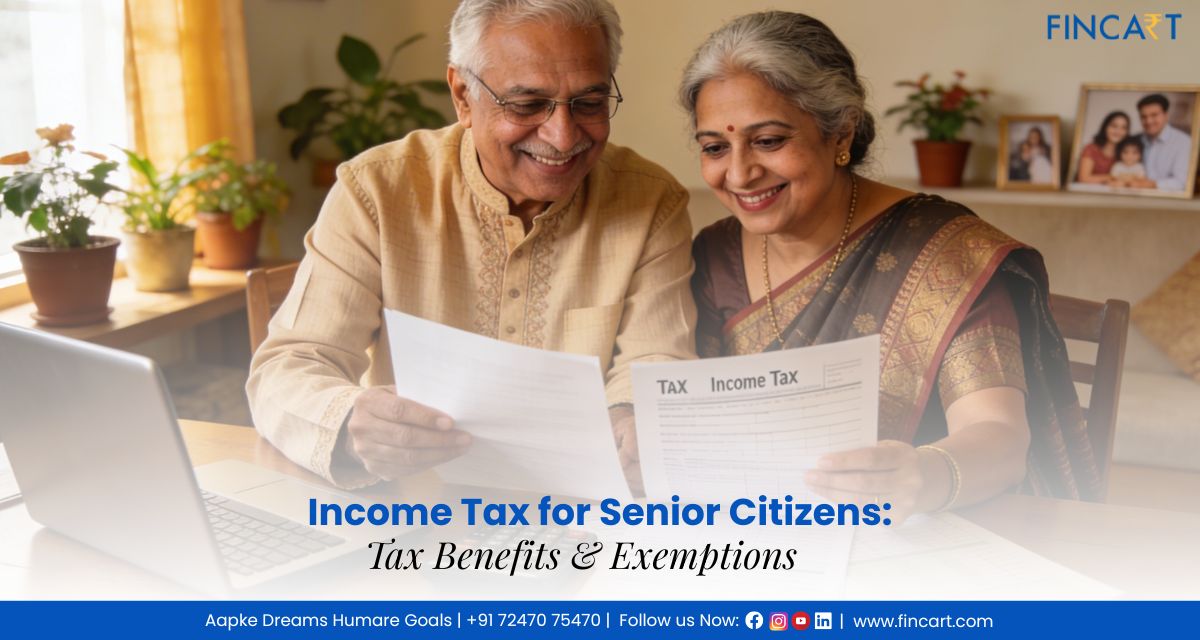
Retirement should give you financial stability, not tax uncertainty. Yet many retirees either overpay taxes or miss legitimate deductions simply because they do not fully understand income tax for senior citizens.
The Income Tax Act provides several concessions to individuals aged 60 years and above. However, you must actively choose the right tax regime, claim eligible deductions, and comply with filing rules to truly benefit.
This comprehensive guide explains the various income tax benefits and exemptions for senior citizens, based on the latest tax provisions in force as of February 2026.
Who Qualifies as a Senior Citizen for Income Tax?
The Income Tax Act specifies the following eligibility criteria:
- Senior Citizen: Resident individual aged 60 years or more but less than 80 years at any time during the financial year.
- Super Senior Citizen: Resident individual aged 80 years or more during the financial year.
Note that only resident individuals qualify for the enhanced benefits under income tax for senior citizens.
Age Attainment Rule
The Income Tax Act follows a specific technical rule when determining age:
A person is considered to have reached a particular age on the day immediately preceding their birthday. This means, if an individual turns 60 on 1st April 2026, the law treats them as having attained the age of 60 on 31st March 2026. As a result, they qualify as a senior citizen for the 2025-26 tax year.
The same principle applies when calculating eligibility for super senior citizen (80 years) benefits. If a person turns 80 on 1st April of a year, the law considers them 80 on 31st March of the previous financial year.
Tax Regimes Available for AY 2026–27
For assessment year 2026–27, senior citizens may choose between:
- Old Tax Regime
- New Tax Regime (Default Regime)
The government made the new regime the default option, but you can opt for the old regime if it benefits you. A professional tax planner can help you choose the optimal tax strategy according to your income pattern, while ensuring all legal compliance.
Understanding income tax for senior citizens starts with comparing the two tax regimes.
Old Tax Regime Slabs for Senior Citizens
Under the old regime, senior citizens enjoy higher basic exemption limits.
For Senior Citizens (60–79 years)
| Total Income (₹) | Tax Rate |
| Up to ₹3,00,000 | Nil |
| ₹3,00,001 – ₹5,00,000 | 5% |
| ₹5,00,001 – ₹10,00,000 | 20% |
| Above ₹10,00,000 | 30% |
For Super Senior Citizens (80 years and above)
| Total Income (₹) | Tax Rate |
| Up to ₹5,00,000 | Nil |
| ₹5,00,001 – ₹10,00,000 | 20% |
| Above ₹10,00,000 | 30% |
These enhanced exemption limits significantly reduce income tax for senior citizens under the old regime.
New Tax Regime Slabs (Same for All Individuals)
Under the new tax regime, the same tax slabs apply to all individuals, including senior and super senior citizens.
| Total Income (₹) | Tax Rate |
| Up to ₹4,00,000 | Nil |
| ₹4,00,001 – ₹8,00,000 | 5% |
| ₹8,00,001 – ₹12,00,000 | 10% |
| ₹12,00,001 – ₹16,00,000 | 15% |
| ₹16,00,001 – ₹20,00,000 | 20% |
| ₹20,00,001 – ₹24,00,000 | 25% |
| Above ₹24,00,000 | 30% |
Under Section 87A (New Regime), resident individuals with taxable income up to ₹12 lakh may receive rebate that reduces tax liability to zero (subject to conditions). This rebate dramatically impacts income tax for senior citizens with moderate retirement income.
Key Tax Benefits & Deductions for Senior Citizens
When evaluating income tax for senior citizens, you must first understand a critical point:
- The old regime allows multiple deductions and exemptions.
- The new regime offers lower slab rates but restricts most deductions.
Under Old Tax Regime
The old regime remains attractive for senior citizens who rely heavily on interest income, medical deductions, or tax-saving investments.
1. Higher Basic Exemption Limit
| Category | Basic Exemption Limit |
| Senior Citizen (60–79 years) | ₹3,00,000 |
| Super Senior Citizen (80+ years) | ₹5,00,000 |
This higher threshold directly reduces taxable income and lowers income tax for senior citizens.
2. Section 80TTB – Interest Income Deduction
Under Section 80TTB, if you are a resident senior citizen, you can claim a deduction of up to ₹50,000 on interest income earned from:
- Bank fixed deposits
- Savings accounts
- Recurring deposits
- Post office deposits
- Cooperative banks
Since these are all common income sources for retirees, this provision can significantly reduce income tax for senior citizens by lowering taxable income directly.
For example, if you earn ₹70,000 as interest from bank deposits during the 2025-26 tax year, you can deduct ₹50,000 and pay tax only on the remaining ₹20,000 only (subject to slab rates).
Additionally, banks do not deduct TDS on interest income up to ₹50,000 per year for senior citizens (compared to ₹40,000 for others).
3. Section 80D – Health Insurance & Medical Expenditure Deduction
Medical costs often rise after retirement age. This deduction provides meaningful relief under the old regime.
| Expense Type | Deduction Limit |
| Health insurance premium (self & spouse) | Up to ₹50,000 |
| Medical expenditure (if uninsured) | Up to ₹50,000 |
4. Section 80DDB – Deduction for Specified Diseases
Section 80DDB allows you to claim a deduction for expenses incurred on the treatment of certain serious illnesses. For the 2025-26 tax year, a senior citizen can claim up to ₹1,00,000, or the actual amount spent, whichever is lower.
The deduction applies to treatment of some specified diseases such as:
- Cancer
- Chronic kidney failure
- Parkinson’s disease
- Alzheimer’s disease and other severe neurological disorders (with prescribed level of disability)
- AIDS
You must obtain a prescription from a specialist doctor working in a government or recognized hospital, as required under the Income Tax Rules. If you receive any reimbursement from insurance or an employer, you must reduce that amount from your claim.
This provision helps reduce income tax for senior citizens who face substantial medical expenses due to serious health conditions.
5. Section 80C – Investment Deductions (If Applicable)
Under Section 80C, you can claim a deduction of up to ₹1,50,000 for eligible investments and expenses during the 2025-26 tax year.
Common eligible investments include:
- Tax-saving fixed deposits
- Life insurance premiums
- Public Provident Fund (PPF) contributions
- Senior Citizens’ Savings Scheme (SCSS) investments
- Equity-linked savings schemes (ELSS), etc.
Although Section 80C is not exclusive to retirees, many individuals continue to invest in these instruments even after retirement. Claiming this deduction can further reduce taxable income and lower overall income tax for senior citizens when you opt for the old regime.
6. No Advance Tax (Without Business Income)
If a senior citizen does not have business or professional income, no advance tax payment is required. This compliance relief applies regardless of regime, but it benefits many old-regime taxpayers.
Under New Tax Regime
The new regime simplifies taxation by offering lower slab rates but removes most deductions.
1. Basic Exemption Under New Regime
Under the new tax regime for the 2025-26 tax year, income up to ₹4,00,000 is taxed at nil rate. Unlike the old regime, the new regime does not provide a higher basic exemption limit specifically for senior or super senior citizens. It applies the same slab structure to all individual taxpayers, regardless of age.
This means that while the new regime offers simplified rates, it does not provide age-based exemption benefits under income tax for senior citizens.
2. Section 87A Rebate
Under the new tax regime, a resident individual with taxable income up to ₹12 lakh can claim a rebate under Section 87A. This rebate reduces the tax liability to zero, subject to applicable conditions and excluding income taxed at special rates (such as certain capital gains).
This provision plays a crucial role in minimizing income tax for senior citizens who earn moderate annual income from pension and interest. In many cases, retirees whose total taxable income remains within ₹12 lakh may not have to pay any tax under the new regime due to this rebate.
3. Standard Deduction (For Pensioners)
Pensioners receiving family pension or salary-like pension may claim standard deduction (as permitted under prevailing provisions) of ₹50,000 on their pension income. This offers limited but meaningful relief under the new regime.
Which Regime Reduces Income Tax for Senior Citizens More?
The choice between the two income tax regimes depends entirely on your income pattern:
- If you claim significant deductions (80TTB + 80D + 80C), the old regime may reduce income tax for senior citizens more effectively.
- If your total taxable income is below ₹12 lakh and you claim few deductions, the new regime may eliminate tax completely due to the rebate.
A tax planner can compute both scenarios before filing and help you choose the optimal regime, ensuring that you do not miss any applicable benefits.
Tax Filing Checklist for Senior Citizens
A little preparation can prevent errors and reduce unnecessary tax payments under income tax for senior citizens. Follow this structured checklist to manage income tax for senior citizens more efficiently:
- Calculate total income from all sources: including pension, interest, rent, capital gains, and others.
- Compare tax liability under the old and new regimes before choosing one.
- Claim all eligible deductions such as Section 80TTB, 80D, 80DDB, and 80C (if applicable).
- Verify Form 26AS and the Annual Information Statement (AIS) for accuracy.
- Submit Form 15H to your bank at the start of the financial year (ideally by April) if your income is below the taxable limit.
- Ensure TDS entries match your records.
- File your return before the due date.
- Keep copies of all medical bills, investment proofs, and tax computation for records.
Following these steps helps reduce errors and ensures smooth compliance under income tax for senior citizens.
When Are Senior Citizens Not Required to File an Income Tax Return? (Section 194P)
The Income Tax Act provides a limited compliance relief for certain very senior citizens. In specific cases, eligible individuals do not need to file an income tax return.
A senior citizen is not required to file a return if all of the following conditions are satisfied:
- The individual is 75 years of age or older.
- The total income consists only of pension and interest income.
- The interest income arises from accounts maintained with the same bank in which the pension is received.
- The individual submits the prescribed declaration to the bank.
- The bank computes the total taxable income and deducts tax at source under Section 194P, after considering eligible deductions and rebate.
When these conditions are fulfilled, the bank takes responsibility for calculating taxable income and deducting the appropriate tax. The individual is therefore not required to file a return.
However, if the senior citizen earns any additional income, such as rental income, capital gains, or interest from another bank, this relaxation does not apply, and return filing may become mandatory under income tax for senior citizens.
Conclusion
Understanding income tax for senior citizens helps retirees protect their retirement corpus and improve cash flows. The law provides structured relief in the form of higher exemption limits, interest deductions, medical benefits, rebate advantages, and simplified compliance rules. However, regime selection requires careful comparison each year. A qualified tax planner or experienced tax consultant can optimize your strategy and ensure full compliance.
With proper planning and timely filing, you can manage income tax for senior citizens confidently and focus on enjoying your retirement years.
Disclaimer: This guide is for informational purposes only and should not be considered as professional tax advice. Tax laws are subject to change. Please consult a qualified tax advisor or chartered accountant for advice specific to your situation.