
ITR filing is not a one-size-fits-all process. The form you file, the mode you choose, and the complexity involved all depend not just on the nature of your income, but also things like residential status. ITR Filing 2026 guide walks you through everything you need to know, including deadlines, documents, the filing process, and how to avoid the mistakes that delay refunds or attract notices.
What Is ITR Filing and Why Should Even Zero-Tax Earners File?
An Income Tax Return is a formal declaration you submit to the Income Tax Department of India, covering your income, tax paid, deductions claimed, capital gains, assets, and losses for the relevant financial year. For Assessment Year 2026-27, it covers income earned between April 1, 2025 and March 31, 2026.
But ITR filing matters even when your income falls below the taxable limit, for quite a few reasons:
- Tax refunds: If your employer deducted TDS in excess of what you actually owe, the only way to claim that money back is by filing a return.
- Loan applications: Banks and NBFCs treat ITR filings as income proof. Most home loan, business loan, and personal loan applications ask for at least two to three years of filed returns.
- Visa applications: Several countries, particularly the US, UK, Canada, and Schengen zone nations, require ITR documents as part of the visa application process.
- Carrying forward capital losses: If you sold mutual fund units or stocks at a loss, you can carry that loss forward for up to eight years to offset future gains, but only if you file on time.
- Financial credibility: A consistent filing history is part of your financial record. It matters when you apply for credit, insurance, or government tenders.
When Is ITR Filing Mandatory?
For individuals, ITR filing is mandatory when total income exceeds the basic exemption limit. Under the New Tax Regime (the default from FY 2023-24 onwards), this limit is Rs. 4 lakh. Under the Old Tax Regime, it varies by age: Rs. 2.5 lakh for those below 60, Rs. 3 lakh for senior citizens, and Rs. 5 lakh for super senior citizens (80 and above).
Beyond income thresholds, there are other specific criteria under which ITR filing becomes mandatory:
- Foreign travel expenditure exceeding Rs. 2 lakh during the financial year
- Electricity consumption expenditure exceeding Rs. 1 lakh during the financial year
- Cash deposits of Rs. 1 crore or more in one or more current accounts
- Business turnover exceeding Rs. 60 lakh during the financial year
- Gross professional receipts exceeding Rs. 10 lakh during the financial year
- Aggregate TDS/TCS of Rs. 25,000 or more during the year (Rs. 50,000 for senior citizens)
- Deposits of Rs. 50 lakh or more in one or more savings bank accounts during the financial year
- A resident and ordinarily resident individual holding any asset outside India, being a beneficiary of an asset outside India, or having signing authority in a foreign account
If any of the above apply, filing becomes mandatory regardless of whether tax is actually payable.
ITR Filing Date 2026: Key Deadlines
The last date for filing ITR AY 2026-27 depends on your taxpayer category. The deadlines, by taxpayer category are:
| Category of Taxpayer | Due Date |
| Salaried individuals and investors | July 31, 2026 |
| Freelancers and small business owners (no audit) | August 31, 2026 |
| Businesses requiring audit | October 31, 2026 |
| Taxpayers with transfer pricing cases | November 30, 2026 |
| Missed the deadline? (Belated return) | December 31, 2026 |
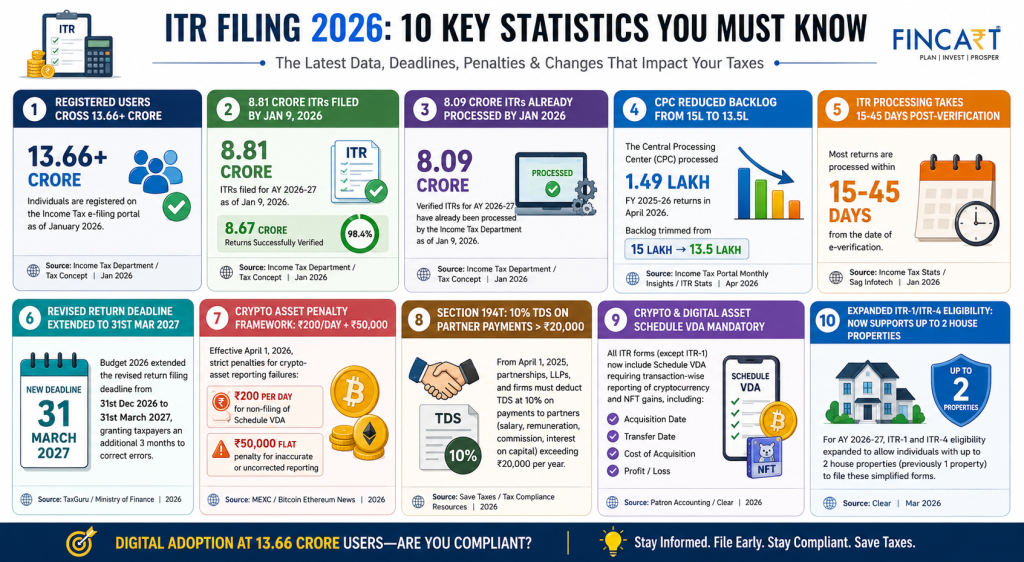
| Need to correct a filed return? (Revised return) | March 31, 2027 |
For the majority of salaried individuals and independent professionals, July 31, 2026 is the ITR deadline to plan around.
Penalties for Late Filing
Missing the due date for ITR filing 2026 has direct financial consequences.
Late Filing Fee: Section 234F
- Income above Rs. 5 lakh: Rs. 5,000
- Income below Rs. 5 lakh: Rs. 1,000
Interest on Unpaid Tax: Section 234A
If you have outstanding tax liability and file late, the government charges 1% per month (simple interest) on the unpaid amount, calculated from the due date until the actual date of filing.
Loss of Carry-Forward of Losses
Filing after July 31 means you forfeit the right to carry forward capital losses, business losses, and speculative losses from that year. This is a benefit that cannot be recovered once the deadline passes.
Delayed Refunds
Late filing pushes your refund processing back by weeks or months, since belated returns are generally processed after on-time filings.
Documents You Need Before You Begin
Organising your documents in advance makes the filing process significantly smoother. Make sure you have the following ready:
Income Documents
- Form 16 (issued by your employer, it summarises salary, TDS deducted, and declared investments)
- Form 16A or Form 16B (TDS certificates issued by banks, tenants, or other deductors outside of salary)
- Form 26AS (the Tax Credit Statement, available on the Income Tax portal)
- Annual Information Statement (AIS) (shows all financial transactions reported against your PAN)
- Bank account statements for the full financial year
- Interest certificates from banks and post offices
- Broker capital gain statement (for anyone who sold stocks, mutual funds, ETFs, or other securities during the year)
- Dividend income statements from stocks or mutual funds
- Rental income details (rent agreements and rental receipts if you own a let-out property)
Deduction Proofs (relevant only if filing under the Old Tax Regime)
- Life insurance premium receipts (Section 80C)
- PPF passbook or account statement
- ELSS mutual fund account statements
- Home loan interest certificate (Section 24B) and principal repayment proof (Section 80C)
- Health insurance premium receipts (Section 80D)
- Donation receipts for eligible charities (Section 80G)
For Freelancers and Business Owners
- Profit and loss statement
- Balance sheet
- GST returns (where applicable)
How to File ITR Online
The ITR filing process can become complex depending on your residential status, the ITR form selected, and the nature of your income. You can file your ITR online through the Income Tax Portal, or use the offline utility and upload it on the portal.
Note: For AY 2026-27, online filing is available for ITR-1, ITR-2, and ITR-4 on the Income Tax portal. Taxpayers filing ITR-3 are required to use the offline utility.
The online filing process for ITR filing 2026 works as follows:
Step 1: Log In to the Income Tax Portal
Go to the income tax portal and log in using your PAN as the user ID. First-time filers need to register using their PAN, Aadhaar, and registered mobile number. Ensure your Aadhaar is linked with your PAN before proceeding as this is mandatory.
Step 2: Download Your AIS and Form 26AS First
Before you start filling in any details, download both your Form 26AS (Tax Credit Statement) and your AIS (Annual Information Statement) from the e-filing portal. Cross-check every entry against your bank statements, Form 16, broker capital gain statements, and rent receipts. If any AIS entry appears incorrect, submit feedback within AIS itself, as this preserves your audit trail and helps prevent notices later.
Step 3: Select the Assessment Year and Filing Mode
Select Assessment Year as AY 2026-27 if you are filing for FY 2025-26, and click on Online, then “Continue”.
Step 4: Select Your Filing Status
Select your applicable filing status: Individual, HUF, or Others and click “Continue”.
Step 5: Choose the Right ITR Form
Before filing your income tax return, it is important to choose the correct ITR form based on your income sources. Here is a quick guide:
- ITR-1 (Sahaj): Salaried individuals with total income up to Rs. 50 lakh, income from up to two house property, and no business income
- ITR-2: Individuals with capital gains, more than two house properties, or foreign income
- ITR-3: Individuals earning from a business or profession
- ITR-4 (Sugam): Small business owners and freelancers with total income up to Rs. 50 lakh, opting for presumptive taxation
If you are unsure which form applies to your situation, a tax consultant can help you identify the correct one before you proceed.
Step 6: Specify the Reason for Filing
You will be prompted to specify the reason for filing your return. Select the appropriate option applicable to your situation.
Step 7: Fill in Income Details, Deductions, and Validate
Most personal details like PAN, Aadhaar, name, contact information, and bank details are pre-filled in your ITR. Carefully review and validate this information before proceeding. Ensure your bank account is pre-validated. As you move through each step, disclose all sources of income, exemptions, and deductions. Cross-check pre-filled data from your employer, bank, and broker, and confirm the return summary. Finally, validate and pay any balance tax due before submitting.
Step 8: E-Verify Your Return
The final step is to verify your ITR within 30 days of filing. If not verified, your return will be treated as not filed. You can e-verify using Aadhaar OTP, Electronic Verification Code (EVC), Net Banking, or by sending a signed physical copy of the ITR-V to CPC, Bengaluru.
How to File ITR Offline
For those who prefer the offline route, or whose ITR form requires it, the filing process works as follows:
- Go to the Income Tax e-Filing Portal and navigate to the Downloads section
- Download and install the common offline utility on your computer
- Open the utility and select the ‘File Return’ option
- Choose ‘Download Pre-fill’, enter your PAN and assessment year, and log in
- Select your status (Individual, HUF, or Others) and choose the appropriate ITR form
- Fill in your general information (personal details and bank account details)
- Enter income details (figures from Form 26AS will be auto-fetched, but add any missing income manually)
- Preview income, TDS, and tax details, proceed to validation, provide your declaration, and download the JSON file
- Log in to the Income Tax portal, click ‘File Now’, select the assessment year and ITR type, attach the JSON file, and proceed to verification
New Tax Regime vs Old Tax Regime: Which Works Better for You?
Since FY 2023-24, the New Tax Regime is the default. You need to actively opt for the Old Regime if you want to use it. The right choice depends heavily on your income level and how much you invest in tax-saving instruments.
New Tax Regime Tax Slabs for Individuals (FY 2025-26)
| Income Slab | Tax Rate |
| Up to Rs. 4 lakh | Nil |
| Rs. 4 lakh – Rs. 8 lakh | 5% |
| Rs. 8 lakh – Rs. 12 lakh | 10% |
| Rs. 12 lakh – Rs. 16 lakh | 15% |
| Rs. 16 lakh – Rs. 20 lakh | 20% |
| Rs. 20 lakh – Rs. 24 lakh | 25% |
| Above Rs. 24 lakh | 30% |
The New Regime also offers a standard deduction of Rs. 75,000 for salaried individuals (from FY 2024-25). However, it does away with most other deductions and exemptions.
Old Tax Regime: Key Deductions Available
The Old Regime has higher base tax rates but allows a broad range of deductions that can meaningfully reduce your taxable income:
- Section 80C (up to Rs. 1.5 lakh): PPF contributions, ELSS investments, life insurance premiums, home loan principal repayment, tuition fees for children
- Section 80D: Up to Rs. 25,000 on health insurance premiums for self and family; up to Rs. 50,000 if parents are senior citizens
- Section 24B: Up to Rs. 2 lakh deduction on home loan interest for self-occupied property
- Section 80CCD(1B): Additional Rs. 50,000 on NPS contributions, over and above the 80C limit
- HRA Exemption: If you are paying rent and your salary includes HRA, a portion is exempt from tax
- LTA: Leave Travel Allowance is exempt for actual travel costs twice in a block of four years
How to Decide?
The right choice depends on your income level and deduction profile. At higher incomes, the Old Regime’s deductions need to be substantial to offset the New Regime’s lower slab rates. At lower-to-mid incomes, even moderate deductions under 80C, 80D, and HRA can tip the balance toward the Old Regime. The only reliable way to decide is to calculate your tax liability under both regimes using your actual numbers — or ask a tax consultant to run the comparison for you. The regime choice is final once you submit, so it is worth getting right before you file ITR for 2026.
Common Mistakes to Avoid
- Selecting the incorrect ITR form can lead to defective returns, penalties, and delays in refunds
- Income earned in FY 2025-26 must be declared in AY 2026-27. Quoting the wrong assessment year may result in erroneous taxation
- Claiming deductions without valid supporting documents may attract a notice from the Income Tax Department
- Not e-verifying your return within 30 days of filing makes the return invalid
- Not reporting FD interest, savings account interest, or dividend income. The AIS flags all of these
- Missing capital gains from mutual fund redemptions or stock sales
- Not reconciling your TDS figures with Form 26AS before submitting
Quick Checklist Before You File ITR in 2026
- PAN linked with Aadhaar
- AIS and Form 26AS downloaded and reviewed
- Form 16 collected from employer
- Bank statements and interest certificates in order
- Correct ITR form identified
- Investment and deduction proofs gathered
- Old vs New Tax Regime comparison done
- Return e-verified within 30 days of filing
Why Choose Fincart for Your ITR Filing 2026?
ITR filing 2026 is manageable when your income profile is straightforward. But the moment you add capital gains, rental income, business income, or foreign assets, it gets considerably more complex.
At Fincart, our tax consulting services are built around your specific income profile. Whether you are a salaried professional, a freelancer with multiple income streams, or an investor with equity and mutual fund positions, our team takes a personalised approach to your return.
When you file with Fincart, you get:
- Personalised assessment: Our tax consultants review your income sources, investments, and deductions before recommending the right tax regime and filing strategy
- End-to-end filing: From document collection to e-verification, we handle the full process
- Error-free submission: Every figure is cross-checked against your AIS, Form 26AS, and Form 16 to ensure no mismatches
- Maximum legitimate deductions: We identify every exemption and deduction you are entitled to
- Post-filing support: If you receive a notice or need to file a revised return, we handle that too
- Transparent pricing: Fixed fees with no hidden charges
The last date for filing ITR AY 2026-27 for most individuals is July 31, 2026, and filing early is always the smarter move. It gets your refund processed faster, gives you room to correct errors, and eliminates the risk of a last-minute technical glitch on the portal costing you a penalty. Tax filing does not have to be stressful. Start early, stay organised, and seek professional consultation if required.
Disclaimer: This article is intended for informational purposes only and does not constitute tax advice. Tax laws and deadlines are subject to change. Please consult a qualified tax consultant before making any filing decisions.