
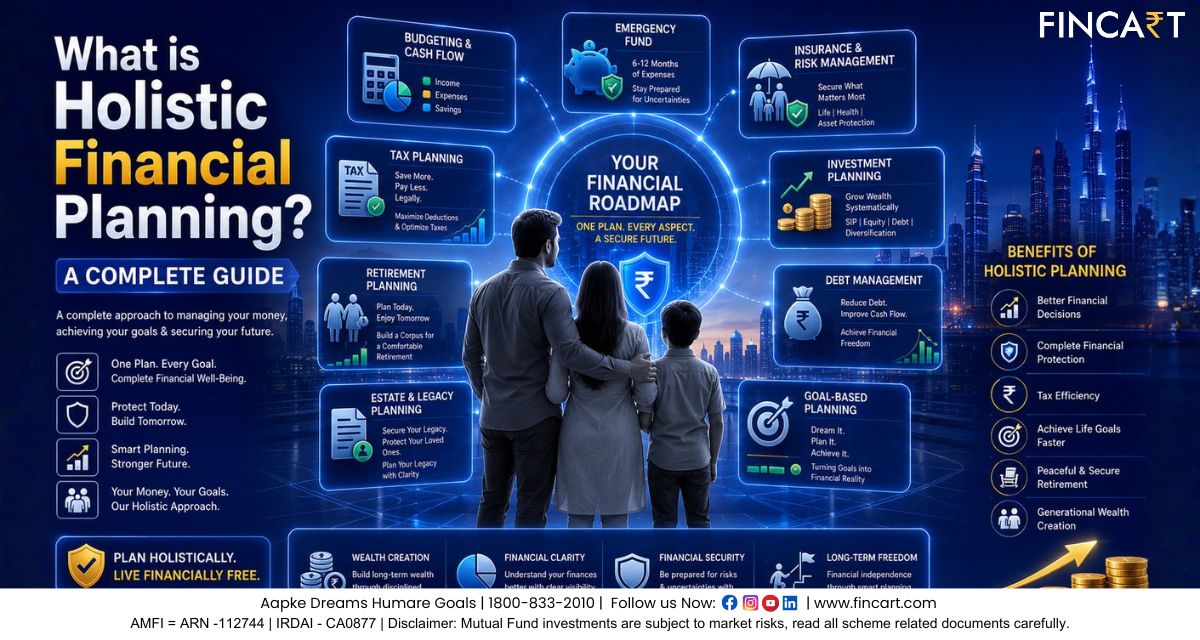
What Is Holistic Financial Planning?
“Holistic” literally means relating to wholes or complete systems. In finance, holistic financial planning means combining all elements of your personal finances into one integrated plan. Instead of treating each financial decision separately (e.g. picking an investment or insurance policy in a vacuum), it looks at how budgeting, savings, insurance, taxes, and investments fit together. This approach creates a unified strategy focused on your goals.
For example, an advisor using a holistic approach will ask: What are your most important life goals? How much cash flow do you need for daily life now? How much do you need to save for the future? What risks (health issues, market drops, job loss) could derail you? By answering these, the advisor builds a plan that covers emergency savings, debt repayment, insurance, and investments, all aligned with your goals.
Contrast this with a traditional or piecemeal approach: you might go to separate professionals for taxes, home loans, and retirement, each working independently. A holistic financial planner instead acts like a conductor, coordinating all parts of your financial orchestra. In India today, a truly holistic plan also means understanding local factors like tax laws (e.g. 80C deductions, new tax regime), investment schemes (PPF, EPF, NPS), inflation, and family responsibilities.
Why Holistic Planning Matters in India
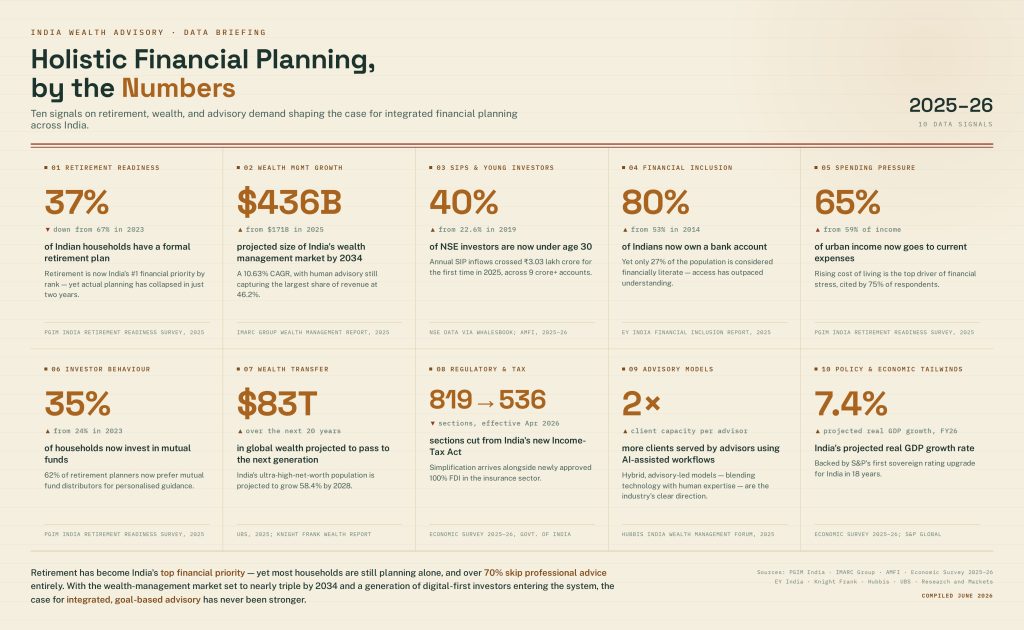
India’s financial landscape is complex and rapidly evolving. Households face decisions on education, weddings, health, retirement, and debt, often without formal planning. Surveys find only about 27% of Indian adults are financially literate – meaning most people may not know how to create a balanced plan themselves. At the same time, mis-selling of financial products is common, making independent guidance crucial.
A holistic plan is important because it:
- Protects against risks: It ensures you have an emergency fund (3–6 months of expenses) and adequate insurance (health, life, home) so that unexpected events (illness, job loss) don’t wipe out your savings.
- Aligns with your values: Instead of chasing the highest returns, you can incorporate values (e.g. ethical investments or saving for family needs) and adjust as life changes.
- Manages taxes: Indian tax rules offer deductions (like under sections 80C/80D) and new regimes. A holistic plan maximizes tax-saving investments (PPF, ELSS, NPS) while still funding your goals.
- Prepares for all goals: It covers not just retirement, but children’s education, weddings, vacations, and any other aspirations, ensuring one goal’s funding doesn’t cannibalize another. For instance, funding a child’s education through ELSS also gives you tax benefits, hitting two targets at once.
- Reduces financial stress: Knowing you have a clear plan can ease worries. Studies show people with written financial plans have fewer money-related anxieties and make better decisions.
In India, it’s better to start early. Even if you’re young, a holistic plan can set healthy habits (like budgeting 50/30/20), start investing, and gradually build retirement or goal funds. Starting late means you need to save more aggressively later.
Key Components of a Holistic Financial Plan
A holistic plan typically includes six key parts that work together:
- Budget and Cashflow Management: Track all income and expenses. Use tools or apps to create a monthly budget (for example, the 50/30/20 rule: 50% needs, 30% wants, 20% savings). Knowing where your money goes is the foundation of any plan.
- Risk Management & Insurance: Determine your risk factors. Maintain an emergency fund (3–12 months of expenses in liquid form) and adequate life and health insurance. For working adults, having life cover of about 10–15× annual income (or 10–12 months of salary in emergency funds) is a common guideline. This protects you against income loss or health crises.
- Debt and Liability Management: Review all debts (home loan, car loan, credit cards) and their impact on cashflow. A plan includes strategies to pay down high-interest debt efficiently (e.g. focusing extra on credit cards or personal loans) and avoid taking on unnecessary loans. Keeping loan EMIs under ~40% of take-home pay helps manage debt safely.
- Tax Planning: Use India’s tax provisions smartly. Make the most of Section 80C (PF, ELSS, home loan principal), 80D (health insurance), 80TTA (interest on savings), etc. Decide between the old/new tax regimes based on your investments. Effective tax planning frees up more money for your goals.
- Financial Goals and Retirement Planning: Clearly define short-, medium-, and long-term goals (e.g. vacation, children’s education, home purchase, business, retirement corpus). For retirement, estimate the corpus needed (a simple rule is “Annual Expenses ÷ 0.04”, adjusting for inflation) and plan through EPF, PPF, NPS, or retirement funds.
- Investment Planning & Asset Allocation: Allocate your investments across asset classes (equity, debt, gold, real estate) according to goals and risk appetite. Label each rupee for a target: <3 years→ debt/hybrid funds, 3–7 years→ balanced funds, 7+ years→ equity mutual funds or stocks. Regularly review and rebalance to stay on track.
Combining these components ensures no piece is missing. For example, funding a retirement goal might involve investing in a balanced mutual fund portfolio, but you also need to consider if you have enough life insurance and pension entitlements. A holistic planner would coordinate all these elements.
Steps to Create Your Holistic Plan
Building a holistic financial plan is a step-by-step process. Here’s a practical roadmap:
- Gather Data & Set Goals (Discovery): Collect all financial data: bank/brokerage statements, loan details, salary, insurance policies, tax returns, etc. List your goals with timelines: e.g., emergency fund (6 months), child’s college (15 years, ₹30 lakh), retirement (age 60, ₹10 crore). Complete a risk-profiling quiz to gauge your comfort with market swings.
- Analyze Current Situation (Assessment): Calculate your net worth (assets minus liabilities). Track your monthly cashflow to see your saving/spending pattern. Identify gaps: Do you have enough term life cover (usually 10–15× income)? Is health insurance in place? How much is your existing retirement fund? Run simple stress tests: use an inflation or retirement calculator to see if current savings will meet future goals.
- Build a Strategy (Plan Design): Now, chart how to achieve the goals. For each goal bucket, assign suitable instruments: short-term goals (<3 yrs) get safer debt funds or FDs; mid-term goals (3–7 yrs) get balanced funds; long-term goals (>7 yrs) go to equity. Ensure tax efficiency: for example, direct part of savings into 80C instruments (PPF, ELSS) if under the old regime. Plan loan payments (e.g., prepay high-interest loans). Incorporate retirement: decide contributions to NPS/EPF or a conservative pension fund.
- Implement the Plan: Put the plan into action in priority order. Typically: set up automatic savings/investments (SIPs into mutual funds, contributions to PPF/EPF); buy insurance policies (term life, health) as needed; establish the emergency fund in a liquid account; start chipping away at debt (refinance high-rate debt if possible). Coordinate with tax filing: claim deductions correctly. Keep all investments and policies in one spreadsheet or dashboard for visibility.
- Monitor and Review: Schedule periodic reviews (at least annually or when major life events occur). Check portfolio performance, reassess goals (e.g., new inflation rates or changed goals), update insurance needs (e.g., after marriage or child’s birth), and rebalance your asset allocation if market movements have skewed it. If something isn’t working (like a fund underperforming), make adjustments.
Following these stages turns a static plan into a living strategy. It ensures that as your income grows or family grows, the plan evolves. For busy Indians, technology can help: use budgeting apps (or even UPI/GooglePay trackers) and government calculators (like NPS or EPF calculators) during the discovery stage.
Holistic vs Traditional Planning (and Robo-Advisors)
To understand the benefit, compare approaches:
- Traditional/Product-Focused: You pick a few goals and related products (e.g. invest a lump sum, buy an insurance plan) often through separate advisors. Each decision is isolated. This can lead to overlaps (too many insurance riders) or gaps (no planning for inflation or taxes).
- Holistic (Comprehensive) Planning: As covered, this is goals-first and covers all areas. It looks at how each decision affects another. For example, a holistic plan might choose a mix of ELSS (for tax) and balanced funds (for growth) so that tax-saving also boosts your investment corpus.
- Robo-Advisors/Automated Tools: These tools use algorithms to allocate your money. They work well for simple scenarios (set risk tolerance, get a portfolio of funds), but often miss nuances: they may not account for your insurance needs, taxes, or personal financial quirks. A purely robo approach lacks personal guidance and emotional coaching. Holistic planning often blends tech tools with human advice for best results.
| Aspect | Traditional Planning | Holistic Planning | Robo-Advisors |
|---|---|---|---|
| Scope | One goal at a time | All goals & financial areas | Investment management only |
| Approach | Bottom-up (product-driven) | Top-down (goal-driven) | Algorithm-driven |
| Personalization | Varies by advisor | Highly customized to individual | Limited to risk profile |
| Coordination | Often siloed (tax, estate, etc.) | Coordinated (advisor ties everything) | Minimal (focus on investments) |
| Cost | May earn commissions on products | Usually fee-based or flat fee | Lower fees, but no holistic advice |
| Flexibility | Can be inflexible over time | Reviewed and adjusted regularly | Limited adjustments unless re-risk profiled |
| Emotional Guidance | Often focused on selling | Emphasis on behavioral coaching | No human guidance |
Holistic planning doesn’t mean you don’t use mutual funds or insurance – you still do – but it means those tools are coordinated. For instance, if your insurance covers disability, you may choose slightly less conservative investments knowing income is protected.
DIY Tools vs Hiring a Financial Planner
You can start your holistic plan yourself, but it depends on your comfort and complexity.
- DIY Essentials: Use budgeting templates or apps to track spend. Maintain an Excel or app to update your net worth monthly. Free calculators from RBI or finance sites can price your goals (e.g., “How much to save monthly for ₹1 crore in 20 years”). Many banks and mutual funds offer SIP calculators or retirement calculators. For emergency funds and insurance, simple rules (6 months’ expenses, 10× life cover) can get you started. Even reading blogs and using knowledge from credible sites (like RBI or SEBI’s financial education materials) adds a lot.
- When to Hire an Advisor: If you have multiple complex goals (owning businesses, overseas education, rental properties), advanced investments (stocks, ETFs, ESOPs) or just feel overwhelmed, professional help pays off. Also, if you suspect you might fall into behavioural traps (e.g., panic selling in market crashes), a planner can coach you through. In India, look for a SEBI-registered Investment Advisor (RIA) or a Certified Financial Planner (CFP®). These credentials mean the advisor is supposed to act in your best interest (fee-only advisors, for example, do not sell products and focus on advice).
A good financial planner will ask many questions about your personal life (job stability, family needs, goals) – a sign they are taking a holistic view. They will also help coordinate with your tax professional or lawyer. Hiring an advisor does cost (either fixed fee or percentage of assets), but consider it an investment if it keeps you from costly mistakes and stress.
Pros and Cons of Holistic Financial Planning
Pros:
- Comprehensive Coverage: All parts of your financial life are considered – no blind spots. You won’t have one part (say, taxes) working at cross-purposes with another (say, investments).
- Aligned Goals: Every rupee has a purpose. You avoid shortchanging a goal; for example, saving for retirement doesn’t starve your home purchase fund, because each goal gets a proper allocation.
- Tax and Cost Efficiency: By planning together, you often save on taxes and fees (e.g., using index funds or direct mutual funds to cut expenses). A holistic advisor might spot that you’re underutilizing tax benefits or paying hidden charges.
- Adaptability: The plan can flex with life changes (new baby, job change, market events). Regular reviews mean you can pivot strategy quickly.
- Peace of Mind: Knowing you have a map for your financial journey reduces uncertainty. It encourages consistent saving/investing behavior.
Cons:
- Time and Effort: Creating and maintaining a holistic plan is detailed. You must gather documents, track data, and review regularly. For busy professionals, this is a significant time commitment.
- Cost: If you hire an advisor, there will be fees (though flat or AUM fees are typically transparent). DIY may have costs too (e.g. software or tool subscriptions).
- Complexity: The plan might be more complex to understand, since it covers many areas. It can be confusing without guidance.
- False Security (risk): Overconfidence in a plan can be risky if it’s not updated. If you skip reviews, the “plan” may become outdated.
Overall, for most people – especially those with a family or significant assets – the pros outweigh the cons. A balanced view helps: many do the basics themselves (budget, emergency fund) and bring in a planner for fine-tuning insurance, tax, and investments.
Summary
In India’s dynamic financial environment, holistic financial planning means taking charge of your entire financial world in a unified way. By aligning your spending, saving, insuring, and investing with your life goals, you build a roadmap for success. Start by assessing your situation and defining clear goals. Work in the six pillars (budget, risk, debt, tax, goals, investments) step by step. Adjust and review as you go. If needed, engage a certified financial planner (CFP®, RIA) who can craft a tailored plan. A well-executed holistic plan boosts your chances of meeting major milestones – from child’s education and home purchase to a comfortable retirement – while minimizing surprises.
Key Takeaways: Integrate all aspects of finance, stay goal-focused, and review regularly. Holistic planning is not a one-time task but an ongoing process. Whether you DIY or hire an expert, the goal is the same: peace of mind and financial confidence through smart, comprehensive planning.
FAQ
What is holistic financial planning?
Holistic financial planning is a comprehensive approach that looks at your entire financial life – income, spending, debt, taxes, insurance, and goals – as one system. It ensures every part of your finances works together toward your long-term objectives. Rather than focusing on one area, a holistic plan creates a unified strategy aligning with your personal values and goals.
Why is holistic planning important?
Because it prevents gaps and conflicts between financial decisions. In India, where only about 27% of adults are financially literate, many people miss out on key benefits (like tax-saving opportunities) or lack protection (emergency funds and insurance). A holistic plan provides clarity, reduces stress, and optimizes resources so that, for example, saving for retirement doesn’t compromise your ability to pay off debt or cover emergencies.
What does a financial consultant (planner) do in holistic planning?
A qualified financial consultant gathers information about your life goals, cash flows, and existing resources. They then coordinate all aspects of your finances – from budgeting to insurance to investments – to build a complete plan. They act in your best interest (especially if they are SEBI-registered or CFP® certified) and often work fee-only to avoid product bias. They also educate and coach you to stay on track.
How do I start holistic financial planning?
Begin by reviewing your current situation: list all assets (savings, investments, property), liabilities (loans, credit cards), income, and expenses. Define and prioritize your financial goals (short-term and long-term). Then identify any gaps: do you have enough emergency savings? Is your insurance adequate? Are you saving enough to meet goals? Based on this, create a plan – set up a budget, start/increase SIPs in suitable funds, buy necessary insurance, and leverage tax deductions. Use free online calculators (for SIPs, goals, retirement) and budget trackers. Finally, review your plan periodically and adjust for changes (new job, marriage, market shifts).
Should I hire a financial planner or do it myself?
It depends. If your finances are straightforward (one income, simple goals, no business), you can start DIY with apps and calculators. But if you have complex needs (business income, multiple goals, international transactions) or want professional guidance, an advisor can be very valuable. Look for advisors who are Certified Financial Planners (CFP®) or SEBI-registered, as they are trained for holistic planning. Remember that true financial planning is about acting in your best interest (fee-only advisory), not selling products.
What do financial planning services typically include?
Comprehensive financial planning services cover goal setting, budgeting, risk and insurance review, tax planning, investment strategy, retirement planning, and estate planning. They might include creating a written plan, regular reviews, and coordination between different experts (like your accountant or lawyer). In India, holistic planners will also advise on government schemes (PF, PPF, NPS) and local tax laws to maximize benefits.
How is holistic planning different from traditional or robo-advisors?
Traditional planning often focuses on specific products or goals one at a time (e.g., just retirement), which can leave other areas unchecked. Robo-advisors use automated algorithms for investments but usually ignore taxes, insurance, and personal advice. Holistic planning is different because it integrates everything – it’s goal-driven rather than product-driven. It also involves personal guidance to navigate life changes and behavioral biases. Robo tools can be useful, but they work best when you already have a solid holistic strategy; otherwise they risk being too narrow.