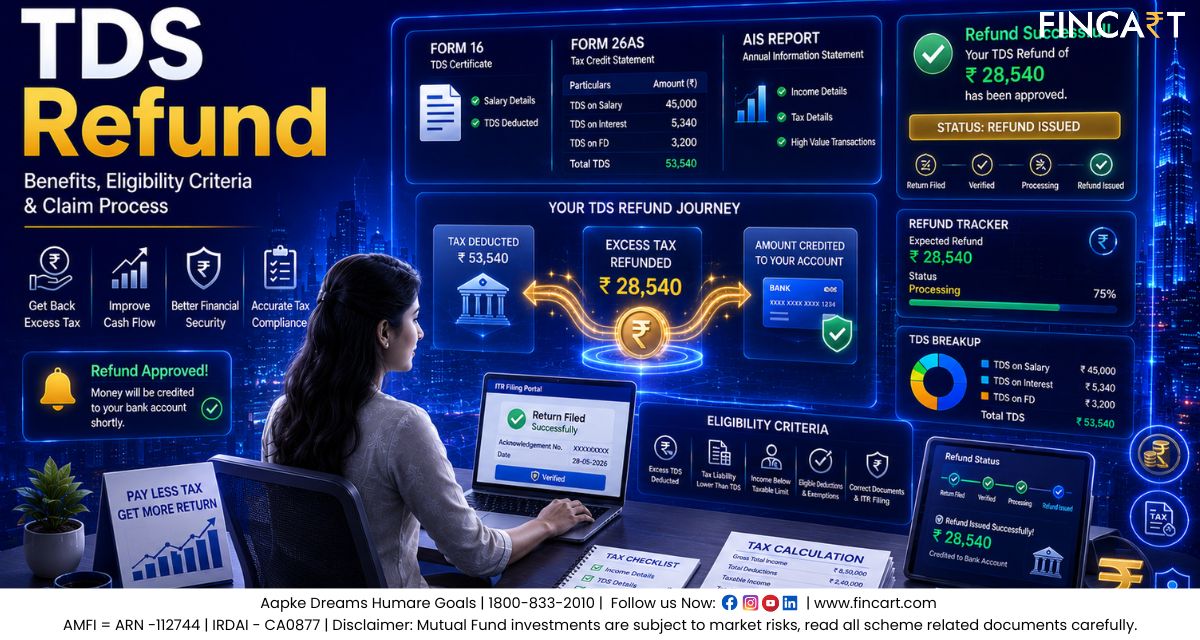
When you earn income in India, whether from a salary, fixed deposit, or freelance work, a portion of it is often deducted as tax before it even reaches your hands. Sometimes, more tax gets deducted than what you actually owe for the year. In that case, the government owes you that extra amount back. This is what a TDS refund is, and claiming it is simpler than most people think. Here is everything you need to know, from eligibility to the exact steps to claim it.
What Is TDS, and Why Does a Refund Happen?
When you earn a salary, receive interest from a fixed deposit, or get paid for freelance work, the person or institution paying you often deducts a portion of your money before handing it over. This deducted amount goes directly to the government. People commonly refer to it as Tax Deducted at Source, or TDS.
The logic is straightforward: the government wants to collect taxes throughout the year rather than waiting for you to file your return at the end. So your employer, your bank, or your client becomes the tax collector on the government’s behalf.
But there is a problem with this, because TDS is deducted at fixed rates without knowing your full financial picture. At the end of the year, when you add up all your income and calculate your actual tax liability, you might find that more tax was deducted than what you actually owe. That extra amount belongs to you. Claiming it back is what we call a TDS refund.
Common Situations Where TDS Refund Applies
You are likely eligible for a TDS refund if any of the following is true:
- Your bank deducted TDS on fixed deposit interest, but your total annual income falls below the basic exemption limit. Under the new tax regime (which is the default for all taxpayers), this limit is ₹4 lakh. Under the old tax regime, it is ₹2.5 lakh for individuals below 60, ₹3 lakh for senior citizens (60 to 80 years), and ₹5 lakh for super senior citizens (above 80 years)
- Your employer deducted TDS at a higher slab rate, but your actual tax liability turns out to be lower, either because your total income is within the rebate limit, or because you claimed deductions under the old tax regime
- You are a freelancer or self-employed professional, and the companies paying you deducted 10% TDS, but your net income after business expenses is much lower
- You received a one-time large payment such as a bonus or commission that triggered a higher TDS deduction
- You invested in tax-saving instruments mid-year and your employer was not informed of these investments before computing TDS
- You are a non-resident Indian (NRI) returning to India, and TDS was deducted at NRI rates even though your residency status changed during the year
- Your total taxable income is below ₹12 lakh under the new tax regime. Thanks to the Section 87A rebate introduced in Budget 2025, you may owe zero tax, making the entire TDS deducted a refundable amount
Benefits of Claiming Your TDS Refund
Many people let their refund sit unclaimed simply because the process seems complicated. But claiming it has real advantages.
- You get your own money back. This is not a government scheme or bonus. You already paid excess tax. Leaving it unclaimed means giving the government an interest-free loan indefinitely.
- You earn interest on delayed refunds. Under Section 244A of the Income Tax Act, if your refund is more than 10% of the total tax payable, the government pays you interest at 6% per annum on the refund amount from April 1 of the assessment year until the date of issue. That is money on top of money.
- It keeps your financial records clean. Filing your ITR and claiming the TDS refund ensures there are no gaps or mismatches in your tax history, which matters if you ever apply for a home loan or visa.
- It builds the habit of financial accountability. When you track your deductions against what you actually owe, you gain a much clearer picture of your income, savings, and tax position.
Eligibility Criteria: Who Can Claim a TDS Refund?
Any individual, Hindu Undivided Family (HUF), firm, or company from whose income TDS has been deducted can claim a refund, provided the total tax deducted exceeds the actual tax liability for that financial year. The key conditions are as follows:
- You must file an Income Tax Return (ITR). A TDS refund is not automatic. You have to file your ITR, report the TDS deducted, and declare your actual income and deductions. Only then does the system calculate whether a refund is due.
- Your PAN must be correctly linked. TDS is credited against your PAN (Permanent Account Number). If your deductor has used a wrong PAN, the TDS will not show up in your Form 26AS or AIS, and claiming it becomes complicated.
- The TDS must actually appear in your Form 26AS or AIS/TIS. These are official tax credit statements available on the Income Tax portal. Before claiming any TDS, verify that the deductor has filed their TDS returns and that the amounts match what you received.
- You must file within the due date, or at least within the extended window. The standard deadline to file an ITR for individuals is July 31 of the assessment year (for FY 2025-26, that is July 31, 2026). Even if you miss the deadline, you can file a belated return up to December 31 of the assessment year. If you want to claim a refund for older years, the Income Tax Act allows you to file updated returns only under specific conditions.
- Your bank account must be pre-validated on the portal. Refunds are issued directly to your bank account via electronic transfer. If your bank account is not verified on the Income Tax portal, the refund cannot be processed.
Documents You Need Before You Start
Keep the following documents ready before you sit down to file for TDS refund:
- PAN card
- Form 16 (from employer) and/or Form 16A (from banks and other deductors)
- Form 26AS or Annual Information Statement (AIS), available on the Income Tax portal
- Bank statements showing TDS deductions
- Investment proofs such as insurance premiums, PPF, and ELSS receipts, relevant if you are filing under the old tax regime
- Home loan interest certificate, if applicable and filing under the old tax regime
- Rent receipts if claiming HRA under the old tax regime
- Pre-validated bank account number with IFSC code for receiving the refund
Step-by-Step Process to Claim TDS Refund
Step 1: Gather and Verify Your TDS Details
Log in to the Income Tax portal at incometax.gov.in using your PAN and password. Go to the Annual Information Statement (AIS) under the “Services” tab. Cross-check all TDS entries shown there with your Form 16, Form 16A, and bank statements. If you spot any mismatch, contact your deductor immediately to correct it before filing.
Step 2: Decide Your Tax Regime
This is a step most people overlook, but it directly affects your refund amount. From FY 2025-26 onwards, the new tax regime is the default for all taxpayers. Under the new regime, the basic exemption limit is ₹4 lakh, the standard deduction for salaried individuals is ₹75,000, and income up to ₹12 lakh is effectively tax-free due to the Section 87A rebate. Deductions like Section 80C, 80D, and HRA are not available under the new regime.
If you have significant investments and eligible deductions, the old tax regime may result in a lower tax liability and a higher refund. Compare both before proceeding.
Step 3: Choose the Right ITR Form
Different income types require different ITR forms. Using the wrong form can delay or invalidate your refund:
- ITR-1 (Sahaj): For salaried individuals with income up to ₹50 lakh, one house property, and no business income
- ITR-2: For individuals with capital gains, more than one house property, or foreign income
- ITR-3: For individuals with business or professional income
- ITR-4 (Sugam): For freelancers and small business owners opting for the presumptive taxation scheme
Step 4: Register or Log In to the Income Tax Portal
If you are a first-time filer, register on incometax.gov.in using your PAN as your user ID. If you’ve already registered, log in and go to e-File > Income Tax Returns > File Income Tax Return.
Step 5: Fill In Your Income Details
Select the relevant assessment year (for income earned in FY 2025-26, the assessment year is 2026-27). Enter all income details including salary, interest income, rental income, freelance income, capital gains, and any other source. The portal pre-fills much of this data from your AIS, but always verify every figure manually.
Step 6: Claim All Applicable Deductions
This step applies only if you are filing under the old tax regime. If you are under the new tax regime, deductions under most sections are not available, though the standard deduction of ₹75,000 applies automatically for salaried individuals. Under the old regime, claim every deduction available to you:
- Section 80C: LIC, PPF, ELSS, home loan principal, tuition fees (up to ₹1.5 lakh)
- Section 80D: Health insurance premiums
- Section 24(b): Home loan interest (up to ₹2 lakh for self-occupied property)
- Section 80TTA/80TTB: Interest on savings accounts or fixed deposits for senior citizens
- HRA exemption and standard deduction of ₹50,000 under the old regime
Step 7: Review the Tax Computation and Refund Amount
Once you fill in all income and deductions, the portal automatically calculates your tax liability. If the TDS deducted is more than what you owe, the difference appears as your refund amount. Review this figure carefully before submitting.
Step 8: Verify and Submit Your Return
After reviewing, submit the return. You then need to e-verify it within 30 days, otherwise your filing becomes invalid. E-verification options include:
- OTP sent to your Aadhaar-linked mobile number (fastest and most common)
- Net banking
- Demat account
- Bank ATM
- Digital Signature Certificate (DSC)
Step 9: Track Your Refund Status
After successful verification, the Income Tax Department processes your return. You can track your TDS refund status by logging into the portal and going to e-File > Income Tax Returns > View Filed Returns. Alternatively, visit the TIN-NSDL website and use the refund status tracker with your PAN and assessment year. Most refunds reach your account within 20 to 45 days, though some take longer.
What to Do If Your Refund Is Delayed or Rejected
If your TDS refund does not arrive within the expected time, go through the following checklist:
- Check your ITR status on the portal to see if they’ve processed your return.
- Check if there is a demand raised by the department. Sometimes the department offsets your refund against any outstanding tax dues
- Make sure your bank account is pre-validated and that the account number and IFSC match exactly
- If the refund was returned due to a wrong bank account, raise a refund re-issue request on the portal under Services > Refund Reissue
In more complex situations such as mismatches in TDS credit, large refund amounts, or notices from the Income Tax Department, seeking professional tax consulting services can save you significant time and stress. Tax consultants know how to navigate these issues systematically and can communicate directly with the department on your behalf if needed.
When Should You Approach a Tax Consultant?
For straightforward cases such as a single employer, no business income, and standard deductions, filing on your own using the portal is quite manageable. But there are situations where a tax consultant adds real value:
- You have income from multiple sources such as salary, freelancing, and capital gains
- You received income from abroad or are an NRI
- You got a notice from the Income Tax Department questioning your refund claim
- The mismatch between your Form 26AS and actual TDS is significant and unresolved
- You are unsure whether the old or new tax regime works better for your situation
- You are filing belated or revised returns for multiple years
A good tax consulting service will not just file your return. They will also review your entire income picture, make sure you are not missing any deductions, and check that the TDS credit is accurate before submission.
A TDS refund is simply the return of your own excess-paid taxes, not a favour from the government. The process, while it looks intimidating at first, follows a clear sequence: decide your tax regime, verify your TDS credit, file your ITR with the correct income and deductions, e-verify, and wait. For most salaried individuals, the entire process takes under an hour. For more complex cases, tax consulting services exist precisely to make sure you do not leave any of your money behind. Make it a habit to file your return every year, check your AIS carefully, and claim every rupee that belongs to you.
Frequently Asked Questions (FAQs)
Q1. How long does a TDS refund take after filing ITR?
Once you file and e-verify your ITR, the refund is typically credited within 20 to 45 days. The timeline can stretch longer if there are mismatches in your AIS or outstanding tax demands. Filing early and keeping your bank account pre-validated usually speeds things up.
Q2. Can I claim a TDS refund without filing an ITR?
No. Filing an ITR is the only way to claim a TDS refund. The refund does not happen automatically, even if the excess deduction is visible in your Form 26AS. You must file your return and let the system compute the difference between TDS deducted and actual tax owed.
Q3. What is the time limit to claim a TDS refund?
For FY 2025-26, the deadline is July 31, 2026. If you miss it, you can file a belated return up to December 31, 2026 with a late filing fee. For older years, you can file an Updated Return (ITR-U) within 48 months from the end of the relevant assessment year, subject to conditions.
Q4. Is a TDS refund taxable?
No, the refund itself is not taxable since it is your own excess-paid tax being returned. However, the interest received on the refund under Section 244A is taxable and must be declared as income from other sources in your ITR for that year.
Q5. What should I do if my TDS refund is not credited?
Check your ITR status on the Income Tax portal to confirm your return has been processed. If processed but not credited, verify that your bank account is pre-validated with the correct account number and IFSC. If there is an error, raise a refund re-issue request under Services > Refund Reissue on the portal.
Disclaimer: This article is intended for informational purposes only and does not constitute tax advice. Tax laws and deadlines are subject to change. Please consult a qualified tax consultant before making any filing decisions.